Hall Effect vs Mechanical Switches: What Can You Reuse?
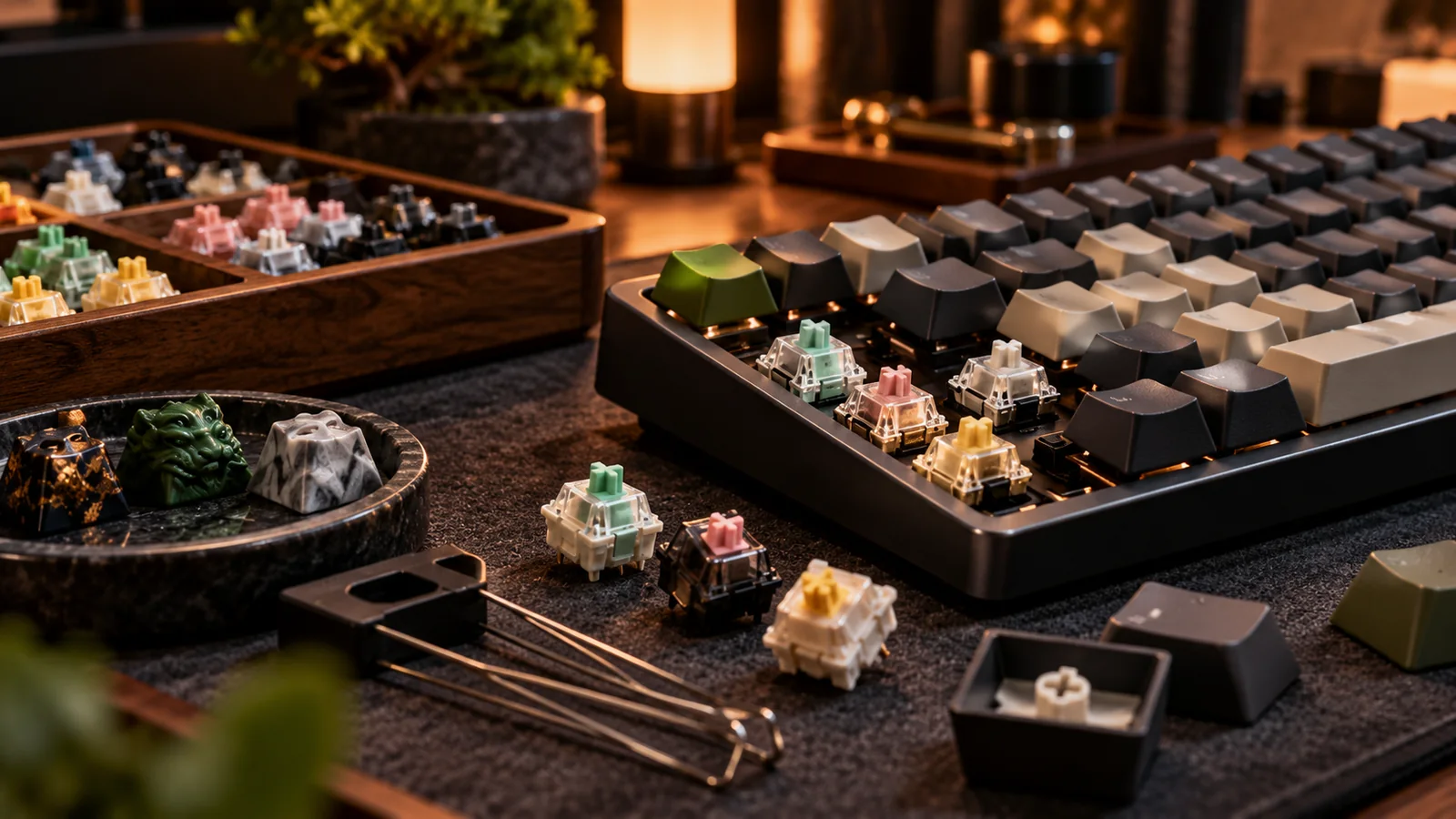
A magnetic keyboard might look like any other mechanical board, with familiar keycaps and a standard compact layout. Underneath, however, its switch detection is fundamentally different. Buyers can sometimes reuse caps, but should not assume they can reuse switches, PCBs or an entire switch collection.
Two ways a press becomes an input
A conventional mechanical switch closes electrical contacts as its stem moves. A Hall-effect board uses a magnetic sensor system to measure movement or position in compatible magnetic switches. That is what enables adjustable actuation and, on supported firmware, rapid-trigger behavior. Those features come from the pairing of switch and PCB electronics, not from a special keycap. Even two magnetic switches marketed as Hall effect may be incompatible if their magnet geometry or calibration differs.
The keycap is often the reusable part
Many full-height Hall-effect switches use an MX-style cross stem, so standard MX-compatible caps can physically attach. But verify actual stem geometry, keyboard layout, stabilizer locations, and whether the case permits the keycap profile’s travel. Low-profile systems are a separate question. A cap fitting the stem does not prove the switch will reach full travel cleanly, nor does it prove the legend kit includes the right 1.75u Shift, bottom row, or international keys. Check a real keycap compatibility diagram before shopping.
What generally does not transfer
Do not plan to insert a conventional MX contact switch into a magnetic PCB or vice versa unless the maker explicitly supports that exact hybrid configuration. Mechanical sockets do not read magnetic position, and magnetic sensing circuits usually cannot interpret electrical contacts. The switch plate, foam stack and case might be reusable only if the PCB has matching mounting points. Firmware, calibration tools and magnetic-switch models can also be vendor-specific. A board marketed simply as hot-swap needs more scrutiny than the familiar buzzword suggests.
Choose based on the actual job
For rhythm-heavy competitive gaming, adjustable actuation can be meaningful. For a writing desk, conventional tactile or linear switches may offer better interchangeability and more mature parts choice. Ask whether the magnetic board’s settings persist without its software and whether support exists on your operating system. If you are buying used, request an input-test video and confirmation that every key calibrates. Treat keycaps as the first likely transferable component; treat everything else as model-dependent until demonstrated.
Before you buy: four things to verify
- Compare the exact PCB technology and supported switch list.
- Confirm MX cross stems and the keycap sizes on your layout.
- Ask whether calibration and rapid-trigger settings require software.
- Avoid buying replacement magnetic switches without model confirmation.
Source and further reading
For the underlying hardware, layout or buyer-protection details, start with Keychron keyboard lineup by switch technology. Always verify individual model specifications with the maker before purchase.
Frequently Asked Questions
Often on full-height boards with MX-style stems, but sizing, height and stabilizer compatibility still matter.
No. Sensor calibration, magnet position and maker-specific support can prevent cross-brand swaps.